Articles
Articles
Each article opens with the direct answer and then goes into the detail. The figures come from the same backtest the console runs on, and update with every new run.
Swap Free Account EA: Compatibility and Cost Checks
A swap free account EA setup only means overnight interest-based swap is removed or replaced; it does not prove robot quality, reduce market risk or imply profitability. Before running an EA, confirm EA permission, allowed symbols, symbol suffixes, admin fees, spreads, commissions and the effect of substitute costs on the backtest. LFP robots require a swap-free account, but the broker choice should come from compatibility checks, not from the phrase “swap-free” alone.
Read the articleLFP Minimum Capital: What a $500 Start Really Means
LFP minimum capital means the robot can start from $500 on a swap-free MT5 account with standard contracts. Below $5,000, LFP runs only part of its logic set; from $5,000 upward, the full current set can run. The $500 level is not a profit promise: the real test is whether a drawdown like 33.9% in the backtest is acceptable for the trader’s finances and behaviour.
Read the articleForex Robot With a $500 Account: Small-Capital Limits
A forex robot with a $500 account should be judged by minimum viable lot size, drawdown tolerance and execution costs, not by whether the deposit meets a vendor’s minimum. On small capital, 0.01 lot, spread, slippage and multiple open trades can quickly become a large percentage of equity. Before expecting returns, define the trade stop, basket stop and system stop.
Read the articleReal Tick Backtest EA: How to Read LFP’s Test
A real tick backtest EA report for LFP is evidence of how the robot behaved on historical data under stated assumptions, not a forecast or guarantee of future return. It should be read through drawdown, real spread, swap-free account conditions, underwater periods and in-sample limitations. The right use of the backtest is to judge past risk and robustness, not to imagine the future from one curve.
Read the articleProp Firm Copy Trading Rules: What the Risk Guard Must Prove
Prop firm copy trading rules mean a copied trade must be risk-authorized before it is technically executed in MT5. The account guard should check firm permission, daily loss, overall loss, account ownership, symbol specifications and execution costs before any signal is copied. LFP PropFirm follows this separation: it does not run its own strategy, but copies the company traders’ manual trades only through daily and overall loss protection.
Read the articleProp Firm Risk Management: Build From Loss Floors
Prop firm risk management should start by calculating the nearest breach level across daily loss, overall loss and any equity-based rule. Until the safe distance to those floors is known, choosing trade size from the profit target can fail the account before the target is reached. A sound plan measures loss capacity first, then sets position size, exposure count and daily stop rules.
Read the articleGrid EA MT5: How a Basket Makes Money and Where Risk Hides
A grid EA MT5 manages staged entries as a basket and may close the whole basket at a shared target. LFP Grid is designed for mostly range-bound markets, but if price trends for a long time, the same structure can build deep floating loss. Its real risk is therefore read on equity, not only on closed balance.
Read the articleIslamic Forex Account for EAs: Swap-Free Is Not Enough
An Islamic Forex Account for an EA removes overnight swap, but it does not remove execution cost, spread, commission, holding limits or symbol rules. Before judging any robot’s performance, the broker’s swap-free terms should be audited against the EA’s markets, holding time and trade size. Swap-free status does not reduce market risk, drawdown, slippage or configuration error.
Read the articlePass Prop Firm Challenge: Start With Loss Floors
To pass prop firm challenge, the plan should start with the daily and overall loss floors, not with a bigger signal. Once a daily drawdown or overall loss limit is breached, the profit target no longer matters. A loss guard can reduce breach risk, but it cannot promise that the account will reach the profit target.
Read the articleUSDJPY BOJ Safe Haven: When Risk-Off Buys Yen
USDJPY BOJ safe haven risk became important again at the end of October 2026 because risk-off trading appeared alongside falling US yields and pressure on the dollar. For yen pairs, the practical question is not whether USDJPY will rise or fall, but whether the current regime is dollar-led, yen-led or yield-led. A risk-first EA should record that regime in its log, pause rules or size controls instead of turning the news into a directional forecast.
Read the articleMT5 Expert Advisor After Go-Live: Weekly Log
An MT5 expert advisor needs weekly monitoring after go-live, not just a successful installation and a green Auto Trading button. A useful weekly log records backtest vs live drift, spread, slippage, Journal and Experts errors, VPS interruptions and every settings change. The purpose is not to predict the market; it is to build evidence that shows whether the EA is still operating inside its tested assumptions and risk limits.
Read the articleMT5 AI Backtesting: What to Automate and Audit
MT5 AI backtesting can speed up test preparation, EA input extraction and repeated scenario execution. It cannot validate robustness unless the trader audits data quality, spread, commission, slippage, tick modelling, EA version and parameter stability. MetaQuotes’ 24 September 2026 update makes the workflow more relevant, but it does not replace human-controlled assumptions.
Read the articleBuying a Forex EA: An Evidence Checklist Before You Pay
Buying a Forex EA is only defensible when its risk, backtest method, execution record and real trading costs can be independently checked. No Forex trading robot is “buyable” just because of claimed profit, screenshots or seller promises. Before paying, review drawdown, stagnation periods, spread, slippage, demo behavior on your broker and your personal stop rule.
Read the articleUSDJPY Oil Prices and Japan Trade Deficit: EA Logs
USDJPY oil prices Japan trade deficit is best treated as a risk-regime problem for a yen EA, not as a buy or sell signal. When oil lifts Japan’s import bill, the robot should log price gaps, Asia-session opening spreads, ATR changes and overlapping yen exposure in USDJPY and GBPJPY. The goal is not to forecast intervention or BOJ policy, but to measure execution quality and portfolio concentration.
Read the articleEconomic Calendar Risk Management Forex EA: CPI to FOMC
Economic calendar risk management forex EA means controlling total portfolio exposure when CPI, PPI, retail sales and FOMC arrive close together, instead of trying to predict the next candle. For a multi-symbol EA, the key task is to measure simultaneous exposure across XAUUSD, USDJPY and sterling crosses and cap portfolio heat before clustered macro events. The result is a rule-based risk process: size caps, new-entry blocks, limits on correlated symbols and post-event drawdown review.
Read the articleEA Risk Settings: What Changes When You Switch LFP Style?
EA risk settings in LFP are controlled by the trading style: Conservative, Brave, Reckless and Mad are predefined risk policies, not four profit forecasts. Switching style changes the risk level, the presence or absence of the drawdown brake, and certain account protections; it does not turn the tested strategy parameters into manual, untested inputs. The style choice should therefore be a decision about loss tolerance, drawdown and broker conditions, not a belief in guaranteed returns.
Read the articleMT5 Expert Advisor: Pre-Live Risk Settings Checklist
An MT5 Expert Advisor should be audited for risk inputs before it is judged by backtest or live performance. The audit should cover symbol mapping, lot sizing, spread limits, stop-loss behavior, magic numbers and account-level safeguards. Without that record, live results cannot be fairly compared with the Strategy Tester or any historical report.
Read the articleXAUUSD CPI Volatility: Backtest the News Window
XAUUSD CPI volatility is not a problem of predicting gold’s direction; it is a measurable execution-and-risk regime for an EA. The minutes before and after CPI should be isolated in the backtest so spread, slippage, drawdown and underwater time are not blended with normal market behavior. This turns the CPI release into a risk decision, not a buy or sell signal.
Read the articleAutomated Trading Robot: Execution, Not Prediction
An automated trading robot does not guarantee or reliably predict the market’s future; its core function is disciplined execution of predefined rules. Its value can be evaluated only when entries, exits, position sizing, loss limits, execution costs and failure modes are visible enough to monitor. The right question is not “will the robot make money?”, but whether its rules and risks can be observed and controlled.
Read the articleCADJPY Oil Yen Divergence: Robot Checklist
CADJPY oil yen divergence means this cross can react at the same time to oil prices, yield spreads and yen shocks. In October 2026, market attention turned to central-bank divergence, oil moves and yen volatility risk, so a CADJPY robot test should separate regimes rather than rely only on the full-period average. This is not a buy or sell signal; it is a risk checklist for systematic traders.
Read the articleForex EA Compatibility Test: What LFP Checks Before You Buy
A forex EA compatibility test at LFP is a free pre-purchase check of your broker’s markets, trading permission, account type, trading hours, minimum lot feasibility, balance and chosen risk style. It also estimates how your broker’s spread and commission would have affected past trades from the LFP live account. The result is not a prediction of future profit; it is an operational readiness check before you pay.
Read the articleGBPUSD UK Budget Volatility: Prepare Without a Sterling Call
GBPUSD UK budget volatility should be managed as an execution-risk window, not as a firm forecast about sterling direction. On 28 October 2026, the UK Budget overlaps with the 27–28 October Fed meeting, creating a setting where spreads, slippage and sterling-pair correlation can change quickly. A systematic trader should define size reduction, pause rules and event logging before the event, then review the data afterward.
Read the articleNo-Grid Forex Robot: Detect Hidden Risk in Trade History
A no-grid forex robot is credible only when its trade history shows no same-direction entry ladder, no lot-size recovery pattern and no uncontrolled exposure build-up. To detect hidden grid risk, check consecutive entry spacing, lot changes, maximum open trades, stop-loss behavior and the relationship between floating drawdown and balance. A no-grid claim does not replace risk management, transparent backtesting or acceptance that losses can occur.
Read the articleProp Firm EA Rules: Code Daily Drawdown Limits in MT5
Prop firm EA rules require a robot to enforce account limits separately from its entry logic, especially the daily drawdown limit. In MT5, conservative control should use equity, start-of-day reference balance, open orders and server time rather than only per-trade stop losses. The goal is not to pass a challenge; it is to prevent mechanical rule breaches.
Read the articleWhat Is an Expert Advisor? A Risk-First MT5 Guide
What is an Expert Advisor? An Expert Advisor, or EA, is a MetaTrader program that executes predefined trading rules and can automate analysis, order placement, or position management. It is not a shortcut to guaranteed profit; its outcome depends on system logic, MT5 permissions, backtest data, execution costs, and risk controls.
Read the articleXAUUSD Volatility After the Yield Shock: What Gold EAs Measure
XAUUSD volatility after the yield shock shows why a gold EA should not define its edge as guessing the next Fed headline or the next gold level. A more defensible edge is measuring ATR, XAUUSD spread, slippage, stop distance, and position size before the trade. When volatility and execution cost rise, reducing size or not trading can be a better statistical decision than entering at full exposure.
Read the articleMT5 contract specification EA: LFP Lot Checks
An MT5 contract specification EA like LFP checks that a buyer’s broker offers the symbol, allows trading, has acceptable costs and reports a consistent one-lot value before the symbol is allowed to trade. If the symbol name, contract terms or lot-value calculation do not match the system’s expectations, LFP opens nothing on that symbol or disables it in the broker-specific build. This broker adaptation is not a profit promise; it is a risk-control layer for reducing differences caused by symbol names, spread, commission, swaps and contract size.
Read the articleNo Martingale Forex Robot: How to Read Risk Claims
A no martingale forex robot only shows that the system does not use the classic pattern of increasing trade size after each loss; it does not prove low risk. To evaluate an MT5 EA, you still need to inspect position sizing, stop logic, exposure stacking, recovery behavior and worst-case drawdown together.
Read the articleWhat Is Profit Factor? Read It Without Ignoring Drawdown
What is profit factor? Profit factor is the ratio of gross profit to gross loss in a trading system, showing how much gross profit was produced for each unit of gross loss. It is not enough to judge an EA because it does not show drawdown, trade count, payoff distribution, execution costs or whether the result was stable over time.
Read the articleWhat the Six-Year LFP Backtest Shows — and What It Does Not
The more than 6 years LFP backtest shows how this Expert Advisor behaved on historical data from 2020, using real spread and overnight swaps. It includes positive figures as well as the difficult parts: a 33.9% maximum drawdown, 40% losing months and 271 below a previous high. It is not a promise of future profit, especially because part of the current result became in-sample after the September and October 2026 strategy additions.
Read the articleOverfitting in EA Backtests: When a Perfect Curve Hides Risk
Overfitting in EA backtests happens when an expert advisor is tuned too closely to historical noise instead of a repeatable market pattern. The result can be a very smooth equity curve, apparently strong profitability and low drawdown that fail on new data or live execution. An EA backtest should be treated as a hypothesis to stress-test with out-of-sample checks and parameter sensitivity, not as proof of future performance.
Read the articleBacktest vs Live Account for Forex EAs: Which Differences Are Normal?
Backtest vs live account differences usually come from order execution, trading costs, data quality, broker symbol settings and market-regime change. Small, explainable gaps are normal; persistent differences in direction, entry and exit timing, trade count or drawdown need a trade-by-trade log. A backtest should be treated as a statistical baseline, not a promise that demo or live execution will repeat every trade.
Read the articleGBPUSD and EURGBP After Fed and BoE: What News Means for a Robot
After the Fed raised rates on September 16, 2026 and the Bank of England held Bank Rate on September 17, 2026, GBPUSD volatility and EURGBP repricing should be treated as event risk, not as a directional signal. federalreserve.gov A rules-based trading robot does not need to react emotionally to central-bank headlines; it needs predefined rules for event windows, volatility regimes, spread behavior and position size.
Read the articleDrawdown and underwater period: two numbers that get confused
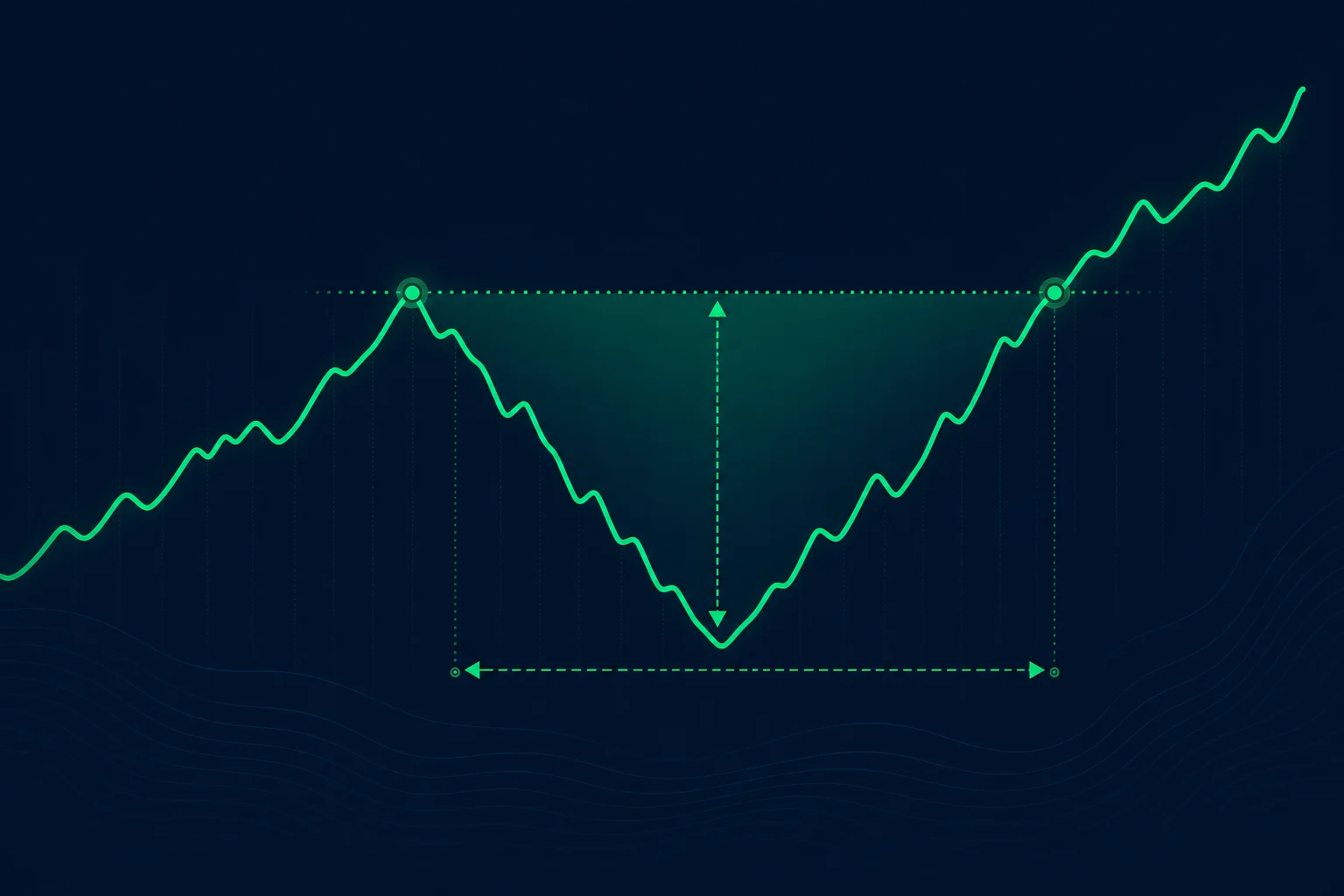
Maximum drawdown is the largest distance an account falls from its own highest point, stated as a percentage. The underwater period is how long the account stays below that previous high, stated in days. The first tells you how deep the loss was; the second tells you how long it took to recover — and it is usually the second that makes a trader give up on a system.
Read the article