
LFP Grid
A grid-basket robot, for range-bound markets
LFP Grid is a robot apart from LFP and LFP PropFirm, with its own licence. It runs a basket of grid and mean-reversion systems on markets that mostly move within a range. A grid carries a risk of its own and we do not hide it: this page says what the robot does, how its risk is set, and who it is not for.
What the robot does
On each market it builds a basket of trades and manages the basket as a whole, not each trade on its own.
A basket of grid and mean-reversion systems
In a range, price tends to come back to its average. The robot profits from that with staged entries and closes the whole basket at one shared target.
Several markets, one basket
Markets that behave like ranges run side by side, so one bad market does not decide the whole account.
The company trader’s trades
The manual entries of the company’s main account (Trader Experience), and every change made to them, happen on your account too.
Markets
GBPCAD, NZDCAD, AUDCAD, AUDNZD and EURUSD. These are the markets that behaved most like ranges in our six-year study.
What keeps the risk in hand
LFP Grid has no account brake: in a drawdown it does not close its baskets at a loss, it waits for price to come back. Instead, the risk is sized from the start:
The right account
The minimum balance is $750, and we recommend starting with $1,500. The account needs leverage of at least 1:500 (ask your broker) and must be swap-free (Islamic). The robot sizes its trades from the balance itself and has no risk setting.
A trend filter
When a market starts to trend, the robot opens no new basket: a grid does its worst damage in a strong trend.
The basket target at the broker
Each basket’s profit target is held at the broker on every one of its trades; if the connection drops, the basket still closes at its target.
A halt from the main account
In unusual markets the company can stop new trades on every account at once.
The risk of a grid, plainly
- In a grid, the further price moves against you, the larger the basket grows; floating loss can run deep even when the basket is eventually closed in profit.
- This robot has no account brake. In the real-tick test from 2020 to today the deepest fall of the account was about 49% and the longest stretch under a previous high about nine months; now and then a basket is closed at a loss that can reach 20–25% of the account. The future can be harder; if you cannot bear a fall like that, do not use this robot.
- A grid is at its weakest in a strong, long trend. The trend filter lowers that risk; it does not remove it.
- Start with a balance whose loss would not upset your life.
Not for a prop-firm account
Prop firms usually forbid grids, and a basket’s deep floating loss does not fit their daily and overall loss limits. For a challenge or a funded account, the LFP PropFirm robot is made for exactly that - and every LFP Grid licence comes with a one-year LFP PropFirm licence as a gift.
Track record
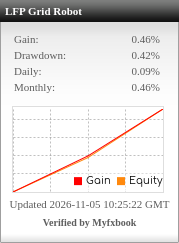
In the real-tick test from January 2020 to 27 October 2026, an account that started with $750 reached about $6,000 in equity. The deepest fall was about 49%, 17 of 82 months closed at a loss, and the longest stretch under a previous high lasted about nine months. The test ran on a swap-free (Islamic) account at 1:500 leverage. It is a backtest result and no guarantee of the future.
LFP Grid licences
LFP Grid has a licence of its own, sold separately from LFP. Each licence covers one real MT5 account, and each comes with a one-year LFP PropFirm licence as a gift.
Lifetime
$3,300/ once, for good
Each additional account: $2,640
- A grid basket on range-bound markets, with a trend filter
- From $750, $1,500 recommended; 1:500 leverage and a swap-free account
- The company trader’s manual trades
- A gift: a one-year LFP PropFirm licence
Annual
$1,300/ year
Each additional account: $1,040
- A grid basket on range-bound markets, with a trend filter
- From $750, $1,500 recommended; 1:500 leverage and a swap-free account
- The company trader’s manual trades
- A gift: a one-year LFP PropFirm licence
Getting started
- 1
Register the account
Sign in to the panel with your email and register your real MT5 account with an LFP Grid licence; the licence key is made at once.
- 2
Pay
Pay for the licence in cryptocurrency. Once payment confirms, that same key starts working, and your gift PropFirm key appears in the panel.
- 3
Install
Download LFP_Grid.ex5 from the panel’s downloads, put it in MetaTrader’s Experts folder, and add the site’s address under Allow WebRequest.
- 4
Run
Drop the robot on a chart, enter the licence key and switch Algo Trading on. There is no risk setting to choose.
LFP Grid questions
LFP uses no grid; so what is LFP Grid?
The LFP robot uses no grid and no martingale. LFP Grid is a robot and a licence of its own that uses grids on purpose, in range-bound markets. That is why it is offered separately, and why we say plainly that it carries a grid’s risk.
What account do I need?
A live, swap-free (Islamic) MT5 account with leverage of at least 1:500 and a balance of at least $750; we recommend $1,500. Below $3,800 the robot runs part of its basket and from $3,800 all of it, sizing every trade from the balance itself.
Why is there no account brake?
Closing grid baskets at a loss at the bottom of a drawdown turns a floating loss into a real one and takes away the basket’s chance to come back. Instead of a brake, the risk is sized from the six-year test. That means a deep fall is possible, and we say so plainly.
Is it suitable for a prop-firm account?
No. Prop firms usually forbid grids. For a prop firm, use LFP PropFirm; a one-year licence for it comes with every LFP Grid licence.
Is profit guaranteed?
No. No trading system guarantees profit, and a grid can build a deep floating loss in a strong trend; the future can be worse than the past.
Leveraged trading carries a high level of risk, and a grid carries its own. LFP Grid has no account brake and does not guarantee any profit, and this content is not investment advice.