
CADJPY Oil Yen Divergence: Robot Checklist
· Updated

CADJPY oil yen divergence means this cross can react at the same time to oil prices, yield spreads and yen shocks. In October 2026, market attention turned to central-bank divergence, oil moves and yen volatility risk, so a CADJPY robot test should separate regimes rather than rely only on the full-period average. This is not a buy or sell signal; it is a risk checklist for systematic traders.
CADJPY oil yen divergence in October 2026
CADJPY oil yen divergence became more than a simple technical story in October 2026 because three drivers were active at once: oil prices, yield spreads and the risk of yen shocks. A systematic trader should not only ask, “What is the next direction?” The better question is, “How does drawdown change if these drivers move together or conflict?”
On 8 October 2026, a report on the Canadian dollar said an oil rally and a narrower Canada-U.S. yield gap gave the loonie some support, while elevated U.S. yields still left it vulnerable. That combination matters for CADJPY because one side of the pair can react to oil and Canadian rates while the other side can react to yen risk and Bank of Japan expectations.
In the same October setting, OANDA’s discussion of central-bank policy divergence noted that CADJPY was testing important resistance and that markets were watching the policy paths of the Fed, the Bank of Japan and other central banks. For a robot, that means CADJPY research should be multi-driver; a full-period average is not enough because it can hide the regimes that create the worst risk.
Oil, Canadian dollar and yield spreads: the CADJPY drivers
The oil and Canadian dollar relationship is important, but it is not sufficient. If oil rises while the market also turns risk-off, CADJPY may behave differently from the simple model of “higher oil, stronger CAD.” That is why every CADJPY backtest should separate periods when oil was the main driver from periods when rates or risk sentiment mattered more.
Yield spreads are slower, but they can still shape the pair. The 8 October 2026 loonie report said that a narrower Canada-U.S. yield differential reduced some pressure on the Canadian currency. For CADJPY, this is not only a daily headline; it is a reminder that the model should be sensitive to changes in the rates backdrop, not just spot price.
| Driver | What it means for a robot |
|---|---|
| Oil and the Canadian dollar | Higher oil can support CAD, but if the move comes from a geopolitical supply shock, risk aversion can change the effect. |
| Yield spreads | If Canadian yields become more attractive versus Japan or the U.S., rate flows can support CAD; a fast reversal in the spread is the risk. |
| Yen shock | The yen can move quickly around intervention risk, Bank of Japan shifts or flight-to-safety flows, challenging tight stops. |
| Technical structure | Support and resistance are useful only when tested with trading costs, spread and drawdown, not as certain forecasts. |
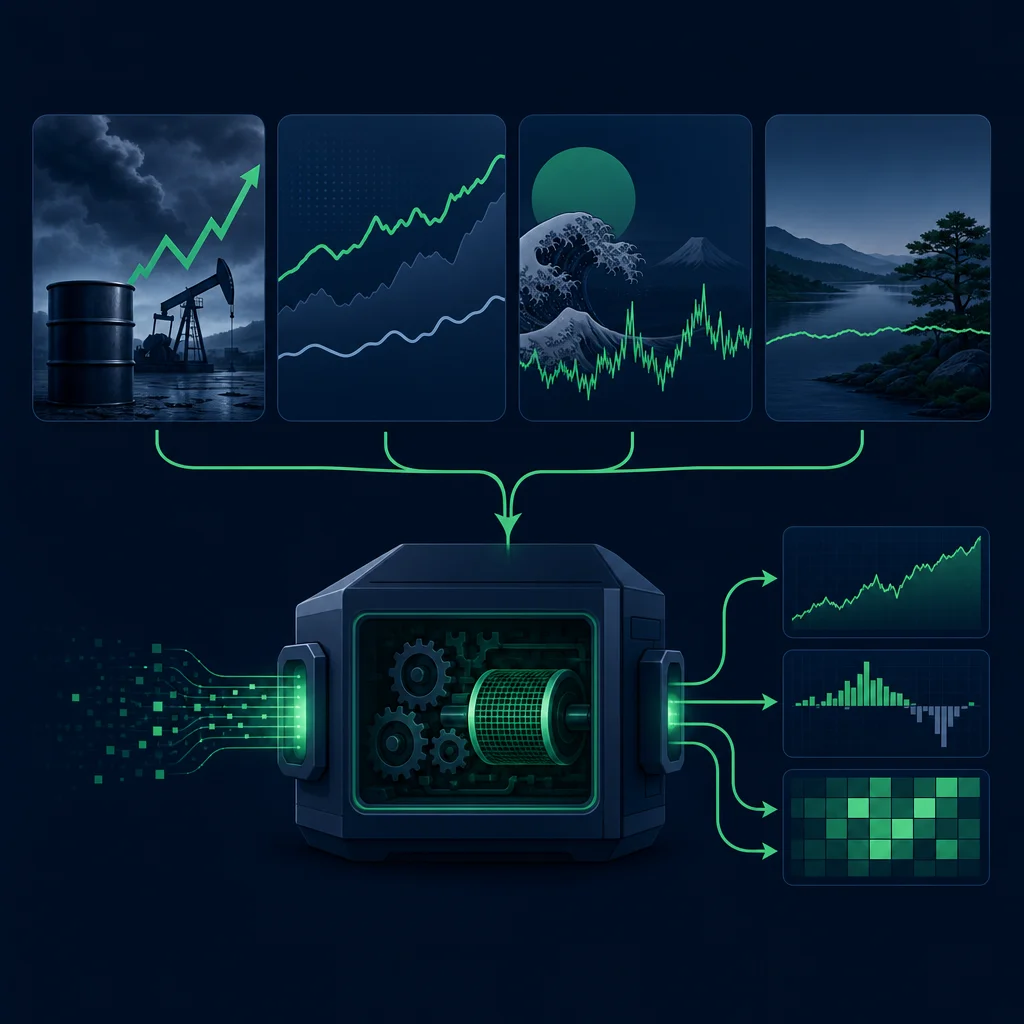
Yen crosses checklist for a multi-driver robot
A yen cross such as CADJPY can appear quiet and then move quickly when expectations for the Bank of Japan change. A market note on 8 October 2026 said several yen crosses, including CADJPY, were under trader surveillance and that late-month RBNZ and Bank of Japan meetings could become volatility factors. That should not be treated as a signal, but it is useful for building test scenarios.
A robot checklist should define what is not a normal market before the next trade is opened. If the system takes the same position size during a yen shock as it does during a quiet session, the backtest may be too optimistic.
- Tag Bank of Japan, Bank of Canada, Fed, inflation and employment dates before analyzing trades.
- Separate oil moves caused by supply shocks or geopolitical news from ordinary commodity swings.
- Use Canadian, U.S. and Japanese yields as market context, not necessarily as entry signals.
- For yen crosses, test spread and slippage separately during thinner liquidity hours.
- Report drawdown by regime: oil-driven, rates-driven, yen-shock and calm market.
Regime filter forex logic in a CADJPY backtest
A regime filter in forex means the robot knows what kind of market it is trading. The filter should not become an excuse to over-tune parameters. It should be an explainable way to separate conditions that change the distribution of returns, drawdown and slippage.
For CADJPY, the filter can be simple and auditable: central-bank decision days, oil jumps, yield-spread shifts and yen shocks. The goal is not to make the past look perfect. The goal is to know whether full-period profit came from one environment or survived across several market environments.
| Regime | Observable sign | Required test |
|---|---|---|
| Oil regime | Large Brent or WTI moves, supply news, geopolitical tension | Test position size, stop distance and slippage separately. |
| Rates regime | Synchronized moves in Canadian, U.S. or Japanese yields | Separate trend-following and mean-reversion trade behavior. |
| Yen-shock regime | Bank of Japan news, possible intervention, sharp USDJPY or yen-cross moves | Stress-test gaps, spreads and emergency exits. |
| Calm regime | No major macro news and limited volatility | Do not let this segment hide weak performance in high-risk regimes. |
CADJPY drawdown inside a multi-market portfolio
A multi-market robot should not evaluate CADJPY in isolation. If the same yen shock also affects GBPJPY, AUDJPY and USDJPY, drawdown can appear across several symbols at once. So a CADJPY review needs both the symbol-level curve and its contribution to total portfolio drawdown.
At LiveForexPower, CADJPY is one of 7 tested markets. A risk-first review means that even if a market was profitable in one period, we still ask how it behaved in the worst trade sequence, in losing months and during time below the previous equity high.
- Do not read net profit alone; review maximum drawdown, time under the previous high and losing months.
- Check whether CADJPY contributed more than its normal share during yen-shock drawdowns.
- If several markets lose together, inspect hidden correlation across CADJPY, GBPJPY, AUDJPY and USDJPY.
- Test spread, swap and slippage for CADJPY specifically because broker contract conditions can change EA results.
- Use out-of-sample testing or at least time splits so the robot is not only adapted to one oil or yen period.
Systematic takeaway: scenarios, not forecasts
A CADJPY outlook for a systematic trader should not be reduced to a directional forecast. The more precise statement is that CADJPY is a multi-driver cross; when oil, yields and the yen are all active, its risk distribution can change.
CADJPY oil yen divergence should therefore enter the research process as a scenario. What happens if oil rises but the yen also strengthens? What happens if the yield spread favors CAD but the market turns risk-off? What happens if a Bank of Japan headline arrives during thin liquidity and slippage expands? These questions improve robot testing without pretending to predict price.
Frequently asked
- Is CADJPY oil yen divergence a buy or sell signal?
- No. It is a risk framework, not a signal. If oil, Canadian yield spreads and yen shocks move at the same time, the robot should already have been tested for position size, entry suspension and exit behavior under those regimes.
- Why does oil affect the Canadian dollar and CADJPY?
- Canada is a major energy exporter, so the Canadian dollar can become more sensitive when oil is a primary market driver. The link is not always linear because interest rates, global growth and risk aversion can strengthen or offset the oil effect.
- What regimes should a CADJPY backtest separate?
- At minimum, separate rising or falling oil regimes, widening or narrowing yield-spread regimes, yen-shock periods and central-bank news days. The goal is to stop drawdown from being hidden inside a full-period average.
- Are yen crosses riskier for a forex robot?
- Yen crosses are not automatically riskier, but they can move faster around possible intervention, Bank of Japan policy changes or sudden risk-off flows. For an EA, the issue is not predicting direction; it is testing slippage, spread, drawdown and correlation behavior.
- What is a regime filter in forex?
- A regime filter classifies the market before the system enters or adjusts risk; for example, an oil-driven market, a rates-driven market, a risk-off market or a calm market. It should not be built to overfit the past, but to make risk control explainable.
This is educational material, not investment advice. All performance figures are backtest results, not live trading, and are no guarantee of future results.