
Grid EA MT5: How a Basket Makes Money and Where Risk Hides

A grid EA MT5 manages staged entries as a basket and may close the whole basket at a shared target. LFP Grid is designed for mostly range-bound markets, but if price trends for a long time, the same structure can build deep floating loss. Its real risk is therefore read on equity, not only on closed balance.
What is a grid EA MT5, and why is it different?
A grid EA MT5 usually manages several staged entries at defined price areas, not one isolated trade with one entry and one exit. The central idea is that, if price keeps moving inside a range, a basket of trades can close together at a shared target or through coordinated exits.
General education on grid trading describes it mainly as a range or fluctuation method: orders are placed at predefined levels, and the main risk appears when price leaves the range or continues in a strong trend. forexbrokers.com
LFP Grid applies that basket logic in MetaTrader 5, but it is sold as a separate product from LFP and LFP PropFirm. It is designed for mostly range-bound markets, sizes trades from the balance, and requires a swap-free or Islamic account.
How basket profit is built in a forex grid robot
In a grid basket, profit does not come from accurately forecasting every market direction. It comes from the assumption that markets do not always move in a straight line and that some movement is rotational or range-based.
When several entries are open at different levels, a price return can move the basket average toward a point where closing the whole basket becomes reasonable. In LFP Grid, each basket has a shared profit target held at the broker on the trades in that basket. If the connection drops, the basket target is still placed; this improves execution discipline, but it does not remove market risk.
The important point is that “basket profit” does not mean “no loss.” A basket may spend time underwater before closing, or under difficult conditions, a basket may be closed at a loss. That is why any honest grid report must show both balance and equity.
- Entries are staged, so one position does not represent the whole risk.
- The basket is managed toward a shared target, so results should be read at basket level.
- If price returns toward its prior area, several entries may close together.
- If price keeps moving away from the range, the same structure can expand floating loss.
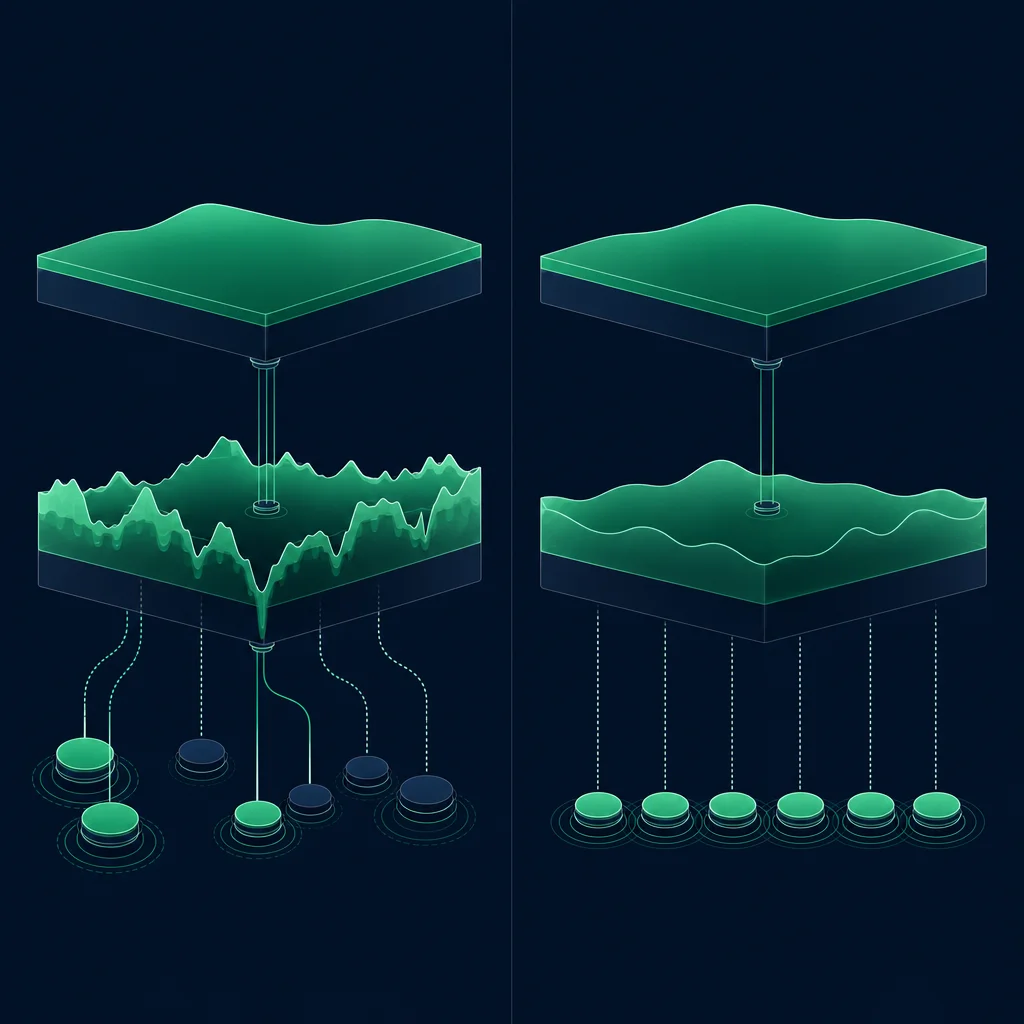
Floating loss, equity and drawdown in an MT5 grid EA
In many grid robots, the balance curve can look smoother than the real account experience because it does not show losses on open positions until they are closed. Equity tells you where the account stands if open trades are valued now.
For LFP Grid, equity is the essential line to read. The grid structure means that, when price moves against the basket, the number and size of open positions may increase; the real pressure appears in floating loss, not only in closed balance.
That is why a fair comparison of any forex grid robot should begin with simple questions: how deep was the equity drawdown in the backtest, how long was the longest period under a previous high, and can the user tolerate that period without emotional intervention?
| Concept | What it shows | Why it matters for a grid |
|---|---|---|
| Balance | Closed trades only | It can look calmer than the real risk |
| Equity | Open floating profit and loss included | It shows the current pressure on the account |
| Drawdown | Should be read on equity | An open basket can create pressure before it closes |
| Underwater period | Time needed to regain a prior high | It tests the trader’s financial and emotional tolerance |
One-way trend risk and the role of a trend filter
A grid is weakest when price leaves the assumed range and keeps moving in one direction instead of returning. Education sources describe this as the central danger: a breakout beyond the grid range can leave open trades with large unrealised losses. oanda.com
LFP Grid uses a trend filter for this risk; when a market starts to trend, the robot opens no new basket. This reduces risk, but it does not remove it. If a basket is already open, or if a trend continues with force, floating loss can still become heavy.
LFP Grid has no account brake. The reason is that forcing a grid basket closed at the bottom of a drawdown can turn floating loss into realised loss and remove the basket’s chance to recover. The practical consequence is also clear: the user must accept the possibility of deep falls before using the robot.
- A trend filter can reduce new entries in unsuitable markets, but it cannot stop a trend.
- No account brake means the user should not expect an automatic whole-account stop.
- Balance-based sizing links exposure to account size, but floating loss can still become deep.
- In unusual markets, the company can halt new trades across accounts, but that is not a substitute for the user’s risk tolerance.
Who LFP Grid is not for
LFP Grid is not for a trader who cannot tolerate deep equity drawdown, several months below a previous high, or an occasional basket closed at a heavy loss. It should only be considered with capital whose loss would not disrupt the user’s financial or personal life.
It is also not the right choice for a prop-firm challenge or funded account. Many prop firms forbid or restrict grids. For that use case, LiveForexPower offers LFP PropFirm separately; it does not run its own strategy and instead copies the company traders’ manual trades through daily and overall loss guards.
LFP Grid is also not for anyone seeking buy or sell signals, price predictions, or a promise of profit. Its design is mechanical and basket-based; it should be assessed through the backtest, equity behaviour, broker compatibility and drawdown tolerance.
| Common assumption | Risk reality | Better reading |
|---|---|---|
| A grid always makes small, steady profit | No; a trend can put the basket under pressure | Read equity and underwater periods |
| A trend filter removes trend risk | No; it only limits new entries under certain conditions | Long trends remain the main danger |
| A rising balance means the account is safe | Not always; open trades may hold floating loss | Equity is the more realistic risk line |
| Any account is enough for a grid | No; the account must be swap-free, MT5-based and suitably leveraged | Account conditions are part of compatibility |
Checklist before running an MT5 grid EA
Before running any MT5 grid EA, first identify the market condition it needs and the condition that harms it. For grid trading, the broad answer is clear: ranging environments are more suitable, while strong trends are the main danger. oanda.com
With LFP Grid, the user should not look for a manual risk slider; the robot sizes trades from the balance. The main decision is made before installation: do your account conditions, capital size, drawdown tolerance and understanding of floating loss fit the grid structure?
If the answer is not clear, read the reports and transparency material first, and review the backtest with a conservative eye. A grid is understood properly only when both sides are visible: the possibility of closing a basket at a shared target and the possibility of deep floating loss during a trend.
- Check that your MT5 account is swap-free or Islamic.
- Confirm leverage and symbol conditions against LFP Grid requirements.
- Read equity and drawdown, not only the balance curve.
- Compare underwater periods with your own tolerance.
- Use only capital whose loss would not damage your life.
Frequently asked
- Is a grid EA MT5 suitable for trending markets?
- Not generally. A grid is usually built for movement inside a range, while a one-way trend can expand floating loss and consume margin.
- Why should a forex grid robot be judged by equity, not only balance?
- Balance shows only closed trades, while equity includes open floating profit and loss. In a grid, the main risk often sits in that floating loss.
- Is LFP Grid the same robot as LFP?
- No. LFP does not use grid logic; LFP Grid is a separate robot and licence that deliberately uses grid baskets and range-reversion logic in range-bound markets.
- What account does LFP Grid need?
- It needs a live, swap-free or Islamic MetaTrader 5 account with at least 1:500 leverage. The robot sizes trades from the account balance and does not give the user a separate risk setting.
- Is profit guaranteed with LFP Grid?
- No. No trading robot guarantees profit, and a grid can build deep floating loss during a long trend; the future can be harder than the backtest.
This is educational material, not investment advice. All performance figures are backtest results, not live trading, and are no guarantee of future results.