
No Martingale Forex Robot: How to Read Risk Claims
· Updated

A no martingale forex robot only shows that the system does not use the classic pattern of increasing trade size after each loss; it does not prove low risk. To evaluate an MT5 EA, you still need to inspect position sizing, stop logic, exposure stacking, recovery behavior and worst-case drawdown together.
Why no martingale forex robot claims matter again
On 14 September 2026, a market-data blog reported renewed search interest in “MetaTrader robot” and “MT5 EA,” which means retail traders are looking at automation again, but not necessarily with a complete due-diligence framework. Google’s own Trends help explains that “Trending now” highlights recent surges across windows such as 4 hours, 24 hours, 48 hours and 7 days; it measures attention, not product quality in the official Google Trends guide.
At the same time, a 19 July 2026 census of 19,619 MetaTrader products found that “martingale” appeared in 1,278 listings, and about 40% of those mentions denied using it as “no martingale” in the 2026 forex robot market report. That makes the phrase a visible trust signal, but it still does not explain how a forex robot controls position size, stops, exposure, or losing streaks.
What a no martingale MT5 EA does not prove
A no martingale MT5 EA may avoid the classic pattern of increasing size after a loss, but it can still concentrate risk in other ways. If the robot opens several correlated positions, keeps stops far away, or allows many trades in the same direction, the account can face large combined exposure even without a martingale sequence.
The 2026 market census found that backtest vocabulary appeared roughly five times as often as live-verification vocabulary in EA listings, so readers should separate historical simulation from observed execution in the claims-versus-proof section. For a systematic trader, a no martingale EA is a first filter, not a conclusion.
| Claim or metric | Practical meaning | Question to ask |
|---|---|---|
| No martingale | Lot size does not follow a classic increase-after-loss chain | Can size still rise for another reason? |
| Risk per trade | How much of the account is exposed before each trade is known | Is it based on balance, equity, or fixed lots? |
| Stop logic | Where a losing trade is supposed to be closed | Is the stop real, visible, and tested? |
| Exposure stacking | How many trades can be open by symbol, direction, or account | Can several small trades become one large risk? |
| Drawdown | The largest fall from a previous equity high to a later low | Are both depth and time underwater reported? |
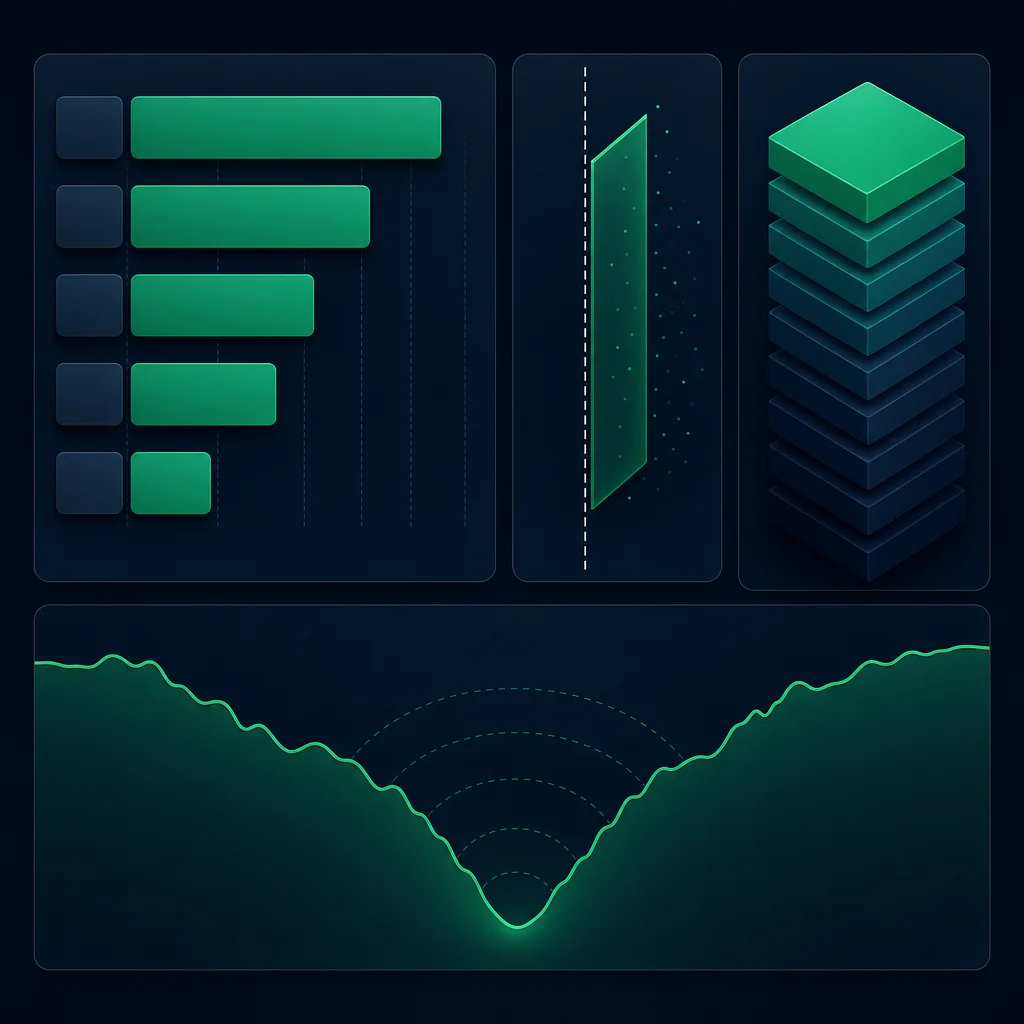
Forex robot risk checklist: position sizing and risk per trade
Start with sizing. If risk per trade is defined, it tells you what part of the account is exposed before the market outcome is known; but if several trades can be open at once, account-level risk may be a multiple of single-trade risk.
The 14 September 2026 discussion of renewed “MetaTrader robot” interest stressed that the term is not a strategy category; an EA could be a scalper, trend follower, grid system, news filter, or a hybrid in the MetaTrader robot trend analysis. That is why your checklist should focus on loss mechanics rather than a product label.
- Read the position-size rule: does the EA risk a defined share of equity, or does it use fixed lots regardless of account drawdown?
- Inspect the stop logic: the stop should be visible in trade records or explained in the rules, not only implied in marketing text.
- Count stacked exposure: maximum positions by symbol, direction, currency and total account should be constrained.
- Watch losing-streak behavior: after several losses, does the EA pause, reduce size, or continue with the same intensity?
- Study the worst segment: average returns are not enough; losing months, underwater duration and maximum drawdown must be read together.
Drawdown, underwater time and recovery behavior
Maximum drawdown tells you how far the account fell from a prior high to a later low in the backtest. Underwater time tells you how long the account stayed below its previous high. These two metrics belong together because a brief sharp drawdown is different from a long, slow recovery period.
Recovery behavior should also be read numerically. If an EA needs more positions, higher exposure, or heavier concentration in correlated markets to return to a prior high, the absence of classic martingale is not enough comfort. Real risk shows up in the path back from loss, not only in the entry rule.
From one symbol to a portfolio: hidden exposure in no-martingale robots
Many traders inspect one trade at a time, but a multi-market robot must be evaluated at portfolio level. If several positions are open in sterling, yen, gold or crypto exposure at the same time, losses may arrive together during a liquidity shock or news-driven move.
A no martingale forex robot should therefore show not only the rule for each trade, but also the limit on total exposure. The central question is not just “does it use martingale?” but “what limits the loss if several markets move against the system at once?”
| Market | Risk to inspect | Backtest question |
|---|---|---|
| XAUUSD | Fast moves and variable spreads can make stop logic and slippage more important | Was the backtest run with realistic spread and commission assumptions? |
| GBPJPY, AUDJPY and CADJPY | Several yen crosses can create shared directional exposure | Is there an account-level cap for related trades? |
| GBPUSD, EURGBP, GBPCAD and GBPNZD | Repeated sterling exposure can create hidden concentration | Is currency exposure aggregated across symbols? |
| ETHUSD | Volatility and trading hours differ from traditional FX markets | Was sizing and stop behavior tested separately for a higher-volatility asset? |
Forex robot backtest: verifying a no martingale EA claim
A useful backtest lets you see the system’s bad behavior. If the report highlights only a rising curve, total profit or positive months while staying quiet about drawdown, losing months or recovery time, it is not enough for a risk-first decision.
For a systematic trader, the best use of a backtest is to estimate risk boundaries, not to certify the future. A no martingale forex robot deserves the same review as any other system: data, execution costs, sizing, exposure, stops and behavior in the worst historical segment.
- The test period should cover multiple market regimes, not only one favorable phase.
- Spread, commission and slippage assumptions should be close to tradable broker conditions.
- The report should show open trades, closed trades, drawdown and negative periods.
- Parameters should not work only at one historical point; nearby settings should remain reasonably stable.
- A backtest result should not be read as a promise of future profit.
Frequently asked
- Is a no martingale forex robot always low risk?
- No. It only says the robot does not use a classic loss-after-loss size increase; risk can still come from large base size, wide stops, correlated trades, or aggressive recovery behavior.
- How should I read risk per trade in an MT5 EA?
- Look at the percent of balance or equity at risk, the stop distance, the lot size, and the number of simultaneous trades. If the vendor shows only fixed lots but not the maximum loss per position, the risk claim is incomplete.
- Why is maximum drawdown more important than the no-martingale label?
- Maximum drawdown shows how far the account fell from its prior high during the worst historical segment. An EA can be no martingale and still create deep drawdown through position stacking or late exits.
- Is a backtest enough to judge forex robot risk?
- A backtest is a starting point, not a final verdict. Data quality, spread, commission, slippage, out-of-sample behavior, and demo or live observation all need separate review.
- What should I ask before choosing a no martingale EA?
- Ask how position size is calculated, how many positions can be open at once, where the real stop loss is, what happens after a losing streak, and what the worst backtest drawdown was. Clear answers to those questions matter more than the label itself.
This is educational material, not investment advice. All performance figures are backtest results, not live trading, and are no guarantee of future results.